

I’ve been coming to Tarpon Springs since I was a kid.
Which, at this point in my life, means I’ve apparently been coming here for a very long time.
Like a lot of Florida families, our version of Tarpon Springs usually meant the Sponge Docks. Walk Dodecanese Boulevard. Look at the boats. Look at the sponges. Go into a few shops. Eat something Greek. Maybe buy something we absolutely did not need.
Then head home.
So when Jodie and I drove up from Dunedin on this trip, I wasn’t exactly expecting Tarpon Springs to surprise me.
It did.
Not because the Sponge Docks had suddenly become something completely different. They haven’t.
It was because, for once, we slowed down enough to look past the version of Tarpon Springs I already knew.
And somewhere between an old memory of a cookie, a restaurant recommendation from a guy we had just met, and a conversation with a woman who clearly wasn’t interested in cutting corners, the place started feeling different.
The Tarpon Springs everybody knows
There are places in Florida where the history has mostly disappeared behind newer development.
Tarpon Springs isn’t one of them.
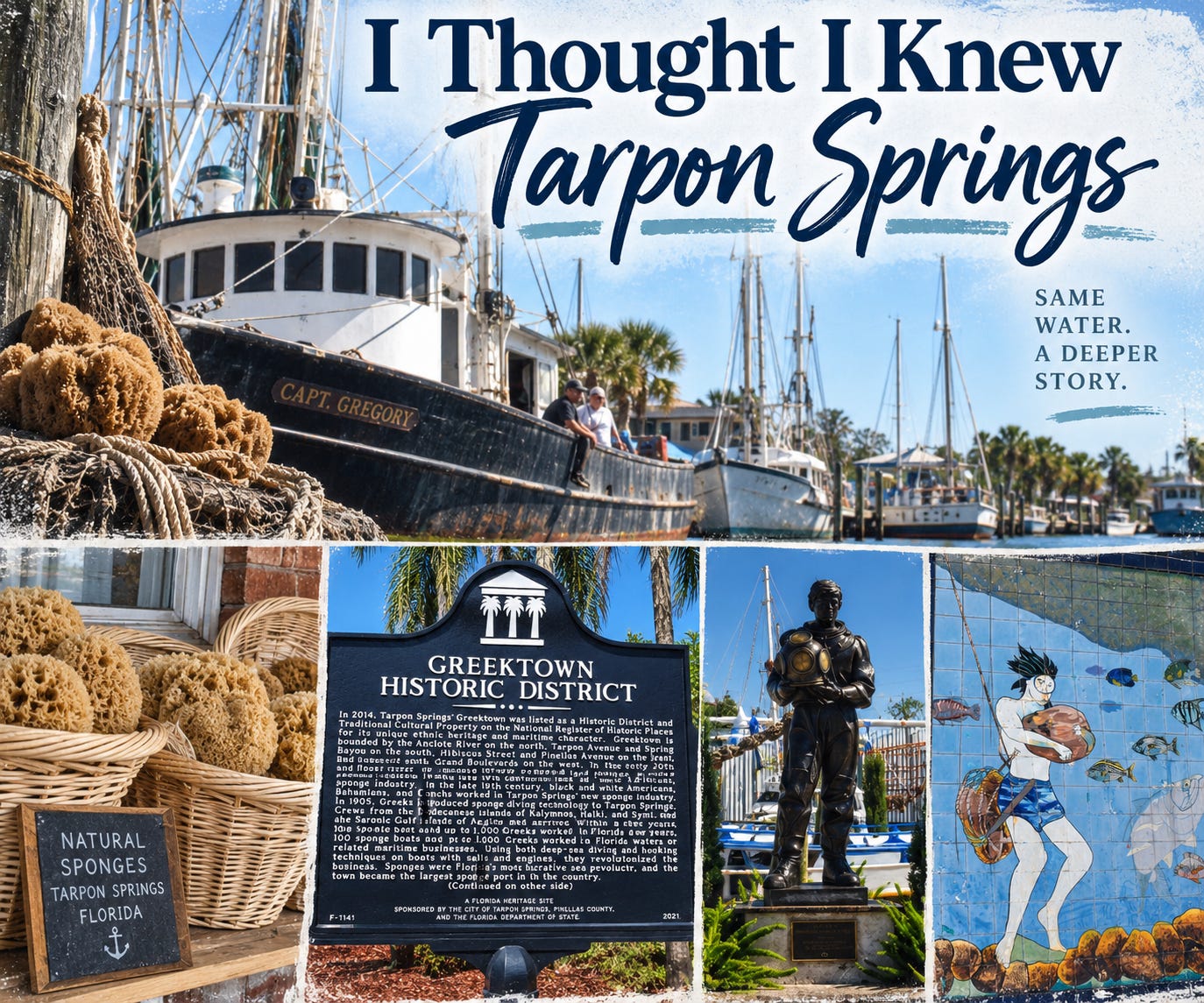
You can still stand along the waterfront and see boats piled high with natural sponges. There are sponge-diver statues, old boats, Greek signs, bakeries, markets and enough blue-and-white decoration to make sure nobody forgets where the cultural influence came from.
But the Greek connection here isn’t just decorating.
And, as I learned, the sponge town isn’t even the first version of Tarpon Springs.
Before the Greek sponge industry transformed the place, Tarpon Springs had already become a winter retreat for wealthy Northerners. The town incorporated in 1887, the Orange Belt Railway arrived that same year, and winter homes began appearing around Spring Bayou. Some of those old houses are still part of the city’s historic character today.
Then came the sponge industry.
Sponging had already begun locally, but the big change came in 1905 when Greek divers and new diving methods arrived. The historical marker we photographed in Greektown says roughly 500 Greek men arrived by the end of that year. Within a few years, around 100 sponge boats were operating and as many as 1,000 Greeks were working in Florida waters or businesses connected to the trade.
It changed Tarpon Springs so much that the city’s own historic survey describes sponge warehouses, packing plants and wholesale businesses overtaking the tourist hotels that had defined the earlier resort town.
That history is still sitting right there along the water.
And once you know a little of it, those boats stop looking like props for tourists.
They become part of the story.
Some things haven’t changed
One of the first places we wandered into brought back a memory I hadn’t thought about in years.
My mother used to buy Greek cookies here when I was little.
I could picture them better than I could describe them — little loaf-shaped cookies, slightly sweet, maybe almond flavored.
So naturally I stood at a bakery counter attempting to explain a cookie from my childhood to a woman who had absolutely no responsibility for solving this mystery.
We got close.
Maybe.
Then the process of figuring out which cookies were available, which could be mixed together and exactly how they were sold became complicated enough that I finally decided I didn’t need a cookie that badly.
Jodie and I walked back outside.
Mystery unsolved.
But I liked the fact that the memory was still there.
That’s one of the strange things about going back to places you knew as a kid. Sometimes you aren’t really looking for a building or a restaurant.
You’re looking for the feeling you remember having there.
Then there was Niko’s
A day earlier in Dunedin, we had met a local real estate agent named Eamon.
At some point, because this is apparently what I do to anyone willing to have a conversation with me, I asked him where we should eat.
Specifically:
Where’s the best Greek food in Tarpon Springs?
His answer was Niko’s Grill House.
So we went.
And this is where our day changed.
Niko’s isn’t memorable because someone designed it to be Instagrammable.
It was memorable because almost immediately it felt like somebody actually cared about what was coming out of the kitchen.
Cristo was our server, and we started with tirokafteri — a spicy feta spread served with seasoned toasted bread.
Good start.
Very good start.
I ordered the pork gyro platter but asked for it deconstructed instead of wrapped up as a sandwich. They let me swap the fries for Greek oven potatoes.
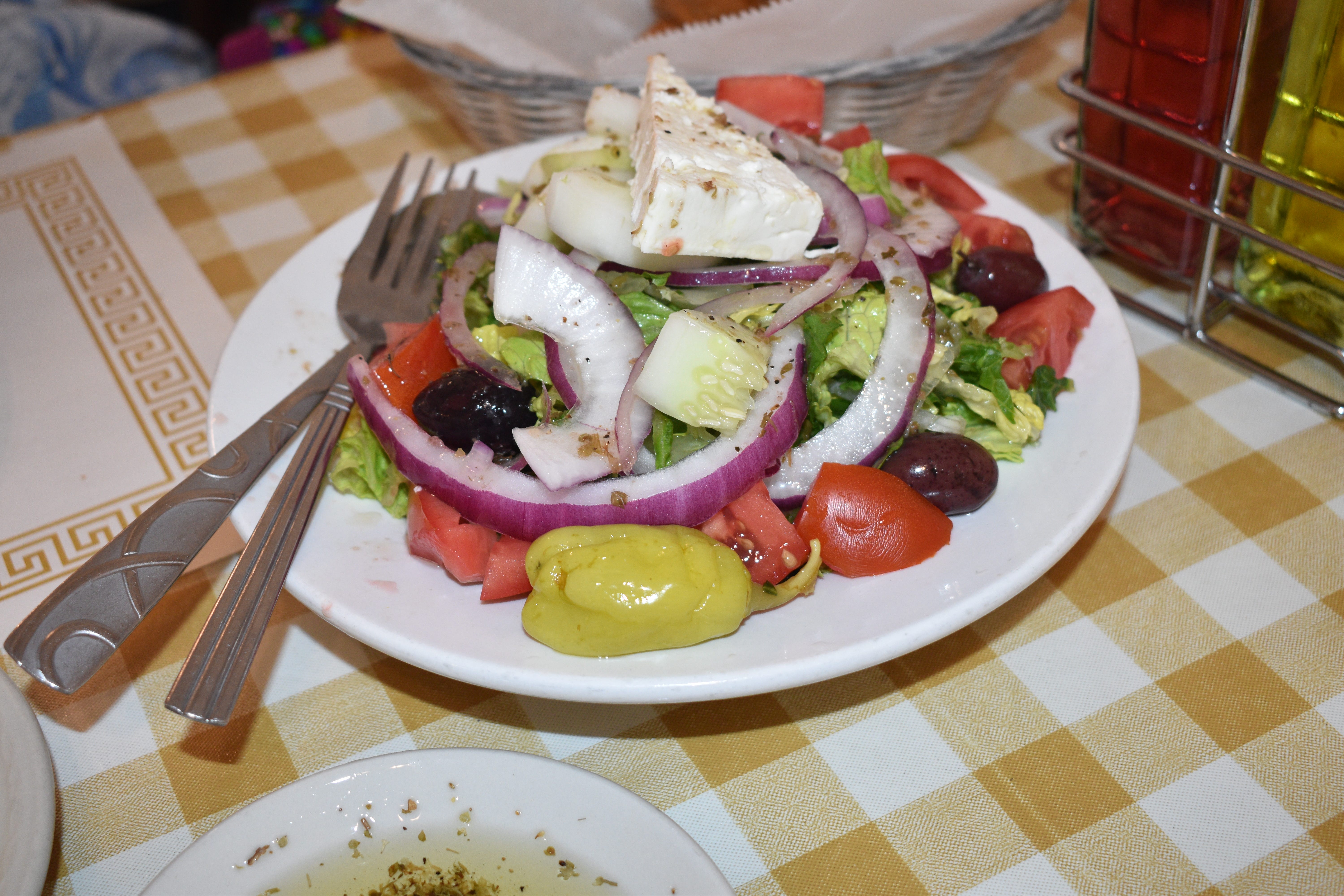
Jodie went with the Tarpon Springs Greek salad.
And yes, if you’ve never had a Greek salad in this part of Florida, there is potato salad hiding underneath it.
Don’t fight it.
Just accept that this is how things work here.
Although, it turns out there is actually a story behind that too.
The Pappas family traces the Tarpon Springs tradition of putting potato salad beneath a Greek salad back about a century. Louis Pappas later opened the Riverside Café in Tarpon Springs in 1925, and his version of the salad became one of those regional food traditions that spread well beyond one restaurant.
Which means even the thing I had mostly accepted as, “Yeah, that’s just how Greek salads come over here,” had a piece of Tarpon Springs history underneath it.
Literally.
The vegetables tasted incredibly fresh. The tomatoes actually tasted like tomatoes, which shouldn’t be remarkable but somehow is.
The pork gyro was fantastic.
I’d never had pork gyro meat like that before, and it was exactly what I wanted without knowing beforehand that it was exactly what I wanted.
The potatoes were lemony without being beaten to death with lemon. The portions were generous. The potato salad was simple and good.
But the food isn’t really what I remember most.
“If it isn’t right, I don’t serve it.”
The owner came over and started talking with us.
Then she kept talking.
And thankfully, so did we.
She talked about running a family restaurant, her son gradually taking on more responsibility, and the problem every person who has ever built something eventually faces:
How do you let somebody else take over when they don’t do it exactly the way you do?
She joked about wanting to retire.
Sort of.
She’d apparently be happy becoming the hostess and letting everyone else handle things.
Except she still sees things that aren’t being done the way she wants.
So retirement may be a work in progress.
I understood that more than I probably should.
What really caught my attention, though, was the way she talked about the food.
She told us she doesn’t give out the exact measurements for her recipes.
Employees may know what’s in something.
They don’t necessarily know how much.
Her reasoning was pretty simple: she doesn’t want someone learning everything in her kitchen and then taking it across the street.
Fair enough.
She also talked about ingredients.
She could substitute cheaper products.
She doesn’t.
She specifically mentioned using real Greek yogurt rather than replacing it with sour cream simply because sour cream costs less.
Her point wasn’t that what she serves is identical to sitting at a taverna in Athens.
Ingredients are different. Meat is different. Milk is different.
But she wants it to be as close as she can reasonably make it.
And then she said something that explained why I trusted the place almost immediately.
If she can’t make something properly, she’d rather not serve it.
Stuffed grape leaves were her example.
They’re labor intensive when they’re made the way she wants them made. Instead of buying premade ones and putting them on the menu every day, she’ll occasionally make them as a special when she has the time and the hands to do it correctly.
That’s the kind of stubbornness I appreciate.
What I didn’t know while we were sitting there was that there was more history behind what she was telling us.
Niko’s about page says Yvonne and Nick Fillis moved their family to Athens in 1993. Five years later they opened a 150-seat taverna there, and their son Sotiris later spent years learning meat cutting and Greek cooking while working between the restaurant and a local butcher shop. Yvonne and Sotiris eventually brought that experience to Tarpon Springs.
So when she talked about what food should taste like in Athens, she wasn’t reaching for a marketing line.
She had a pretty good basis for comparison.
Fresh means fresh
At one point we were talking about how fresh everything tasted.
She told us they cut things as they need them.
Not because that’s the easiest way to run a restaurant.
Because that’s how she wants the food served.
She also said she doesn’t recycle yesterday’s leftovers into tomorrow’s meals. Leftover food goes to staff and sometimes to people who need it.
Her attitude was basically:
You can eat leftovers at home.
You aren’t paying her to serve them to you.
Again, stubborn.
Again, I liked her immediately.
By the time she brought us watermelon at the end of the meal, Jodie and I had stopped feeling like we had just gone somewhere for lunch.
We’d had one of those travel experiences we always seem to remember more than the attractions we’re supposedly there to see.
We met somebody.
The tourist part is still worth seeing
After lunch we wandered around some more.
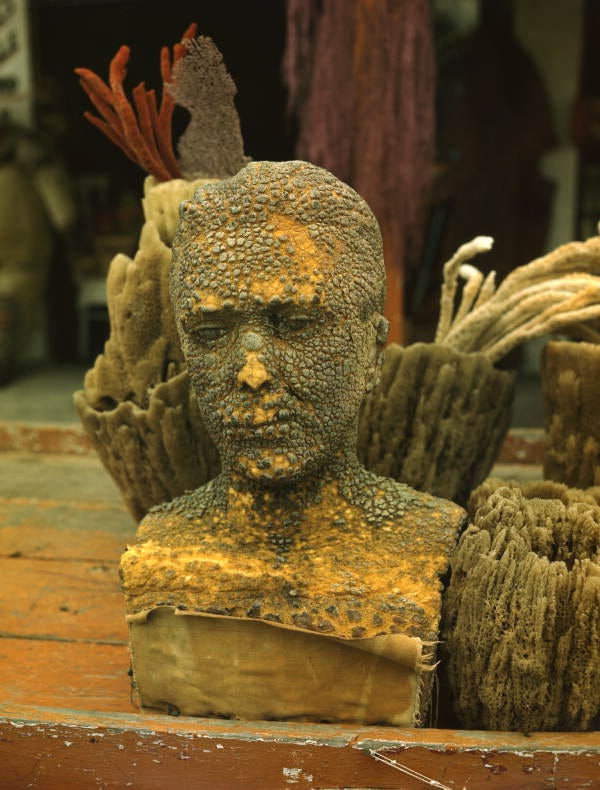
We photographed the boats and sponge-diver statue. We walked along the waterfront. We looked through shops filled with natural sponges, shells and Greek products.
And yes, some of the Sponge Docks are unapologetically touristy.
There’s even a giant shark hanging upside down.
Nobody is going to confuse that with an untouched Mediterranean fishing village.
But that’s okay.
Tourism has become part of the place too.
And the more I looked around, the more I realized that trying to decide whether the Sponge Docks are “authentic” or “touristy” is probably the wrong question.
They’re both.
The souvenir shops are real.
The giant shark is real.
And so are the boats, the sponge history, the churches, the restaurants and the Greek-American community that grew up around this waterfront.
Tarpon Springs itself recognizes both its historic downtown and Greektown as distinct historic areas, which says something about how many layers of the city are sitting practically on top of each other.
The trick is not stopping at the souvenir shops and assuming you’ve seen the whole place.
Walk a little farther.
Read the historical markers.
Look behind the shops.
Notice the working boats mixed in with everything built for visitors.
And when someone who knows the area tells you where they eat, listen.
It wasn’t Dunedin — and that’s the point
At one point Jodie and I were walking around and one of us said something along the lines of:
“This definitely isn’t Dunedin.”
It isn’t.
It isn’t Safety Harbor either.
Those places have their own personalities.
Tarpon Springs feels rougher around some of the edges. More commercial in some places, more working-class in others, and occasionally a little chaotic.
There are parts I like more than others.
That’s okay too.
Travel doesn’t require pretending every place is perfect.
What Tarpon Springs has is something a lot of Florida destinations have gradually lost:
A very specific identity.
The sponge boats belong here.
The Greek bakeries belong here.
The churches, markets, family restaurants and old stories belong here.
Even the giant upside-down shark somehow belongs here.
And the funny thing is, I still haven’t seen all of it.
The Tarpon Springs I knew growing up centered on the Sponge Docks.
But the older resort-town story still survives around Spring Bayou, where wealthy winter visitors were building homes before the sponge industry changed the city. Greektown tells another part of the story. Downtown tells another.
After coming here since childhood, I realized I had mostly been visiting the same few blocks and assuming I knew the town.
Turns out I knew my version of it.
That’s not quite the same thing.
Would we go back?
Absolutely.
I’d go back to Niko’s tomorrow.
There are more places I want to explore, more history I want to understand, and apparently a Greek cookie from somewhere in my childhood that I still need to identify.
I’m stubborn too.
I’ll find the damn thing eventually.
Trip Jar Takeaway: If you’re visiting Tarpon Springs, absolutely see the Sponge Docks. They’re famous for a reason. But don’t make the mistake of treating them like the entire city. Wander beyond the obvious stops, learn why the Greek community is here in the first place, and leave room in your day for the recommendation you didn’t plan.
Sometimes that’s where the trip actually happens.