

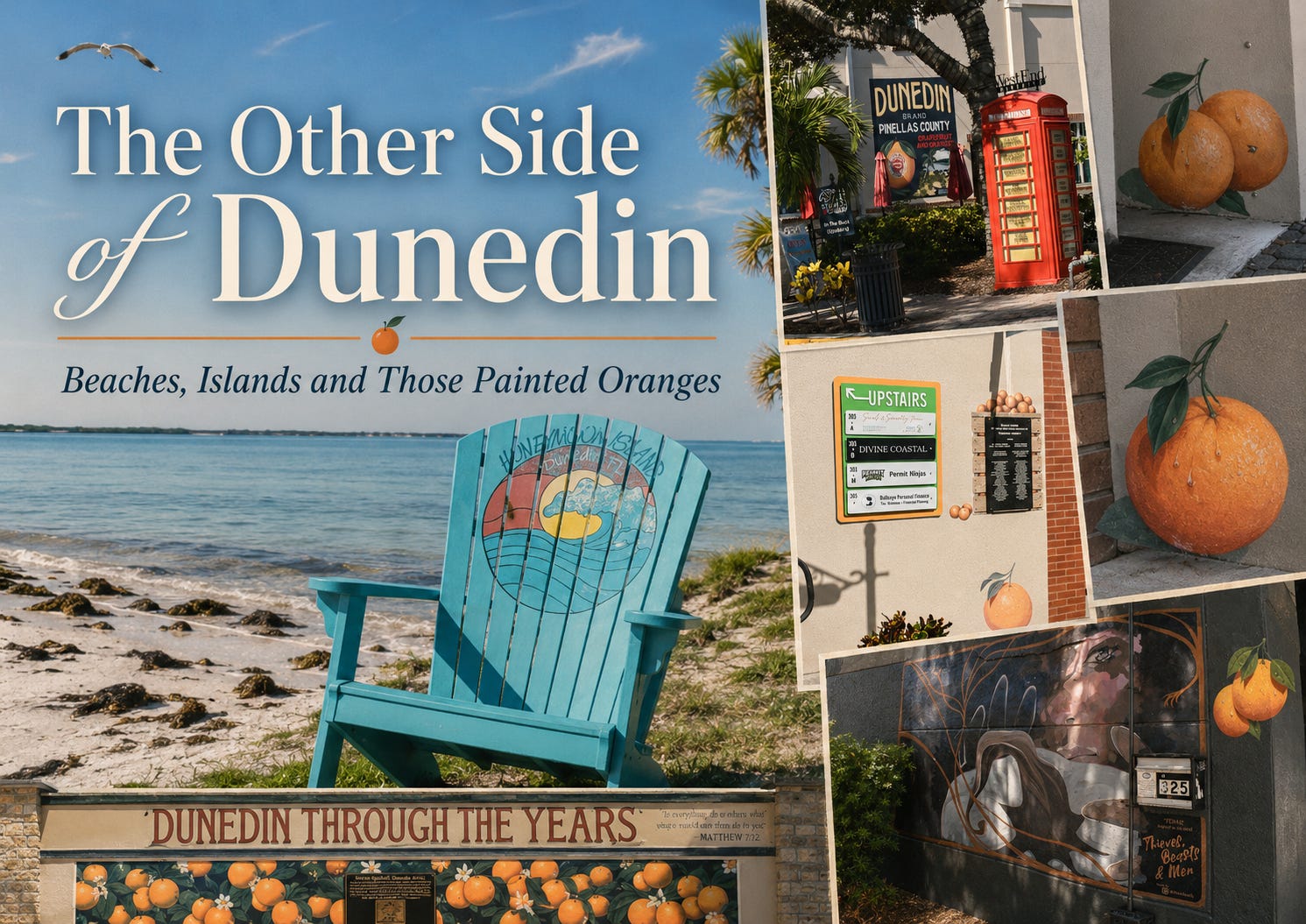
Downtown Dunedin gets most of the attention, and I understand why. It’s walkable, full of locally owned restaurants and shops, and has enough personality to keep you wandering for hours.
But there is another side of Dunedin that helps explain the place just as much.
You find it when you drive west toward the water.
And you find it again when you start noticing oranges painted on buildings all over town.
At first, those two things sound like they have nothing to do with each other.
They do.
Out Toward Honeymoon Island
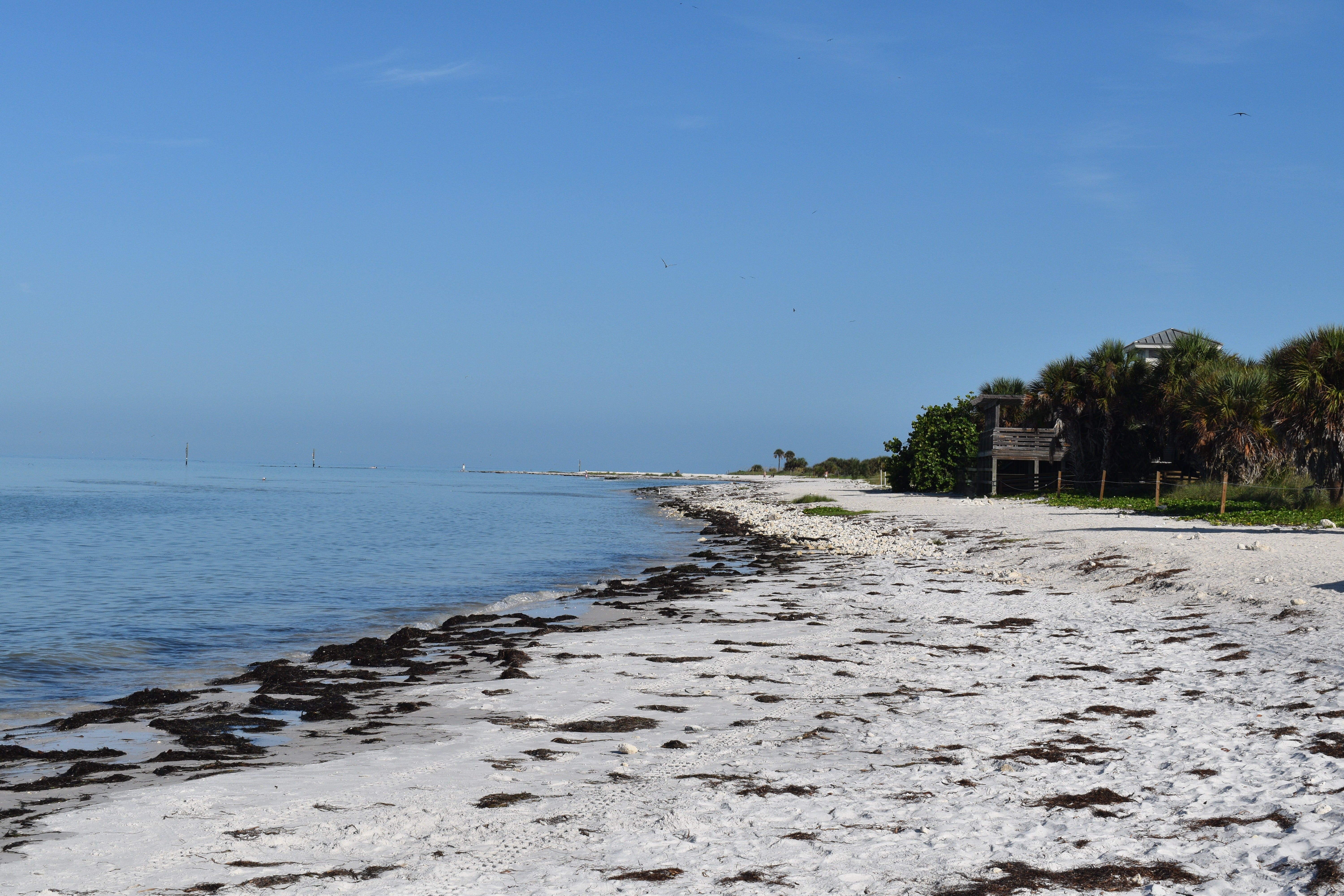
One morning, Jodie and I headed out early toward the Dunedin Causeway and Honeymoon Island State Park.
Early was intentional.
August in Florida has a way of turning a pleasant walk into a character-building exercise by lunchtime, and I wanted pictures before the causeway filled up. The morning was already hot and strangely still, but there is something about driving out there before everything gets busy that changes the whole feel of it.
The road stretches west with St. Joseph Sound on either side, and suddenly downtown Dunedin feels much farther away than it actually is.
People fish from the causeway. Kayaks and paddleboards slide through the shallower water. Boats move out toward the Gulf. Beyond them sit the barrier islands that protect this stretch of coast.
That last part is easy to forget when you are looking at pretty water.
These islands are not just beaches somebody happened to build a road toward. They are constantly shifting pieces of Florida.
Honeymoon Island itself is a barrier island shaped by storms, currents, erosion and sand movement. In fact, Honeymoon and nearby Caladesi were once a single island known as Hog Island until the 1921 hurricane cut a pass between them.
Florida has been rearranging the furniture ever since.
Honeymoon Island Is More Than a Beach
We paid the entrance fee and headed into Honeymoon Island State Park, which sits just a couple of miles west of Dunedin.
The park has more than four miles of shoreline, but it also protects one of the remaining stands of virgin slash pine forest in the area. Ospreys, shorebirds, gopher tortoises and other wildlife all call the island home.
We stopped at the Rotary Centennial Nature Center, which turned out to be one of the more useful stops of the morning.
The nature center explains both Honeymoon and Caladesi, along with the wildlife, seagrass beds and ecology around them. There is also an elevated observation area looking across the sound, which gave us a better sense of what we were actually looking at instead of simply saying, “Well, that’s pretty water.”
And it was pretty water.
The morning was almost unnaturally still. We walked around, looked over the seagrass beds, took pictures and tried to convince ourselves we should walk farther.
We did not walk much farther.
I could pretend there was some environmental reason for that.
There wasn’t.
It was hot, and apparently we were lazy that morning.
I’m comfortable with that.
The Name “Honeymoon Island” Was Basically a Marketing Campaign
One of the things I like about travel is when the name of a place turns out to have a better story behind it than you expected.
Honeymoon Island qualifies.
In the late 1930s, businessman Clinton Washburn bought the island. According to Florida State Parks, he mentioned to a friend from Life magazine that it would make a great place for honeymooners. The idea turned into a publicity campaign, honeymoon cottages were built, and the first couples arrived in 1940. In total, 164 couples took part before World War II changed the island’s use.
So, yes.
Somewhere in the history of this beautiful Florida island was essentially a tourism marketing meeting.
As somebody currently building a travel business, I have to respect the commitment.
Caladesi Is Right There. Getting There Is the Interesting Part.
From Honeymoon Island, you are looking toward Caladesi Island State Park, which is one of the more undeveloped barrier islands left along this part of Florida’s Gulf Coast.
We did not make Caladesi a separate stop on this trip, and I’m not going to write as though we did.
But if you are planning your own Dunedin trip, you need to understand how the two islands fit together because visiting Caladesi is not as simple as driving across another bridge.
There isn’t one.
Caladesi is accessible by boat. For most visitors, the easiest way there is the Caladesi Connection ferry, which leaves from inside Honeymoon Island State Park. The ferry ride across St. Joseph Sound takes about 20 minutes, and the standard ticket allows up to a four-hour stay on the island. Private boats and kayaks are other ways to reach it.
As of this writing in 2026, ferry service has resumed after storm damage from Hurricane Helene affected parts of the park. Some marina services remain limited, so this is definitely one of those things I would check before showing up with an entire day planned around it.
The ferry currently departs from the docks at Honeymoon Island, with tickets purchased there rather than online. Schedules and prices can change, so I would use the ferry operator or Florida State Parks for the current information rather than relying on a six-month-old travel blog.
Including mine.
That seems fair.
Why Caladesi Is Different
Caladesi is what a lot of people picture when they imagine finding the quieter Florida beach that somehow everybody else missed.
Of course, everybody else knows about it too.
But being accessible only by water naturally keeps it different from beaches where you can pull into a giant parking lot and walk 100 yards to your umbrella.
Florida State Parks describes Caladesi as one of the few relatively untouched islands along the Gulf Coast. Visitors can walk its beaches, explore the interior trail, paddle through mangroves or just spend a few hours doing absolutely nothing.
That last option has become increasingly attractive to me.
We have discovered that Jodie and I are perfectly capable of taking a relaxing vacation and somehow turning it into a research assignment.
Take pictures.
Find the history.
Look at the menu.
Talk to the bartender.
Write this down.
Go check that.
By about two o’clock that afternoon, we had made ourselves a deal.
We were done driving around.
Jodie wanted the pool back at the Fenway.
And frankly, she was right.
Sometimes the most intelligent thing you can do on vacation is stop gathering material for an article about the vacation.
Then There Are the Oranges
Back in town, there is something else you start noticing once somebody points it out.
Oranges.
Painted oranges.
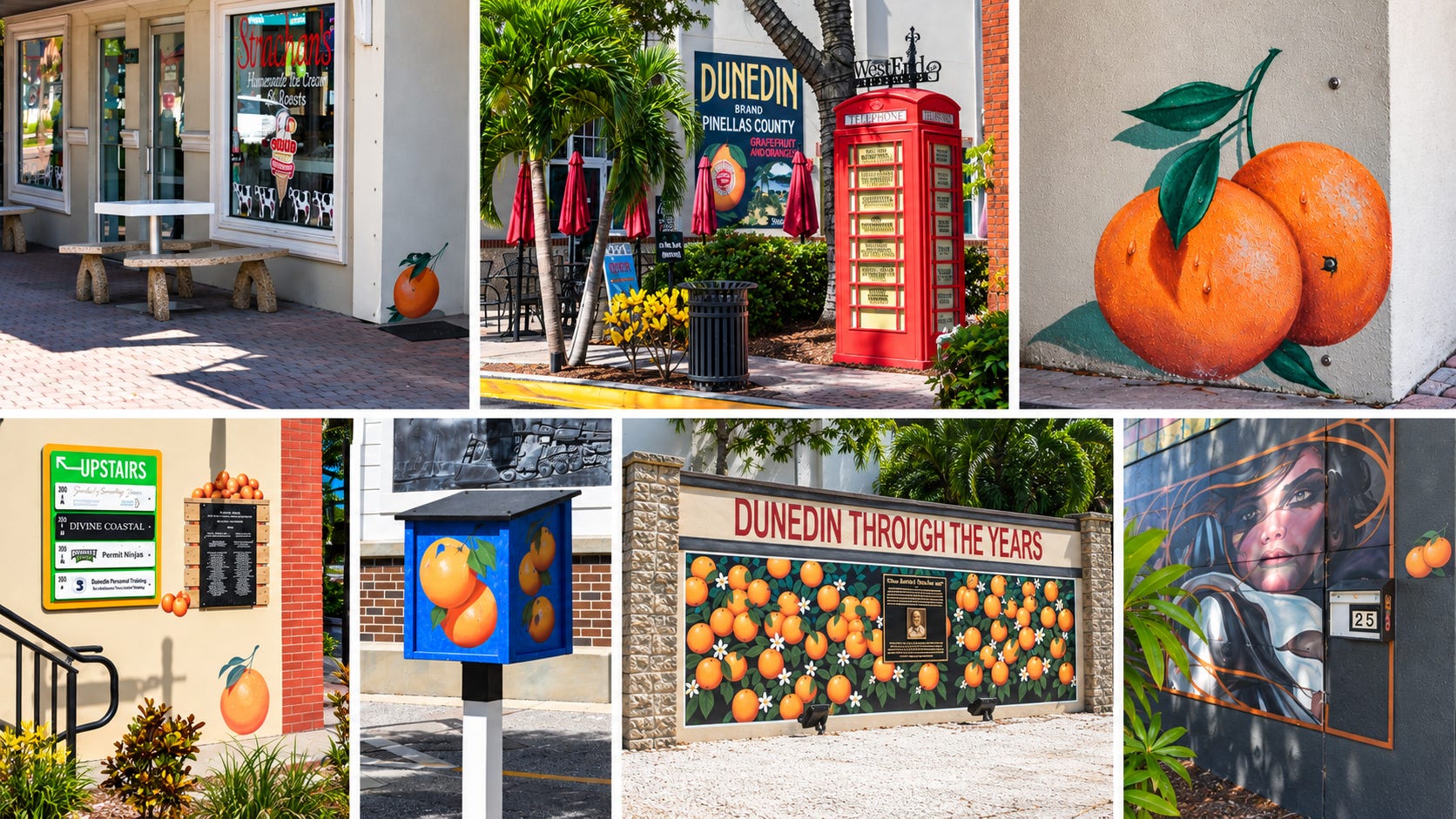
They show up on businesses, walls, doors and homes throughout Dunedin.
Some are small enough that you almost walk right past them. Others are incorporated into larger murals. Once you start looking, it becomes something of a scavenger hunt.
Naturally, I wanted to know why.
The answer turns out to be part history, part public art and part somebody deciding to do something slightly illegal before breakfast.
My kind of story.
The Night Dunedin Got “Fruited”
On April 13, 2009, local artists Steve Spathelf and Marsha Goins went around downtown Dunedin in the early morning hours and secretly painted oranges on seven locations.
They did not exactly go through the normal public-art permitting process first.
The oranges were inspired by vintage citrus-crate labels and Dunedin’s long relationship with the citrus industry. The reaction was apparently the exact opposite of what you might expect when people wake up and discover somebody has painted fruit on their buildings.
People loved them.
Businesses started asking for their own. Residents began looking for the oranges around town. What started as seven unauthorized little paintings turned into one of Dunedin’s most recognizable pieces of local identity.
The timing mattered too.
This was 2009, in the middle of the financial crisis, when businesses everywhere were struggling. The idea was partly about bringing attention to public art and partly about bringing people into downtown Dunedin.
It worked.
The Oranges Aren’t Random
The orange itself was not chosen simply because Florida grows oranges.
Dunedin had a significant citrus industry stretching from the town’s early years into the middle of the 20th century. The Dunedin History Museum still devotes an entire permanent exhibit to that history, including the Skinner family, citrus packing and the development of orange concentrate.
The railroad mattered too.
The Orange Belt Railway helped connect Dunedin to larger markets, making it easier to move citrus and helping the town grow. The old train depot now houses the Dunedin History Museum, and the former rail corridor eventually became part of the Pinellas Trail.
So when Spathelf began using images inspired by old orange-crate artwork, he was not inventing a theme for tourists.
He was pulling something out of Dunedin’s own past and putting it back on the walls.
The plaque we found around town told the story of Spathelf and Goins beginning the orange paintings during that rough economic period and of Spathelf eventually reaching 1,000 painted oranges.
At that point, I think you officially stop being the guy who painted some oranges.
You become the Orange Guy.
A Town That Doesn’t Take Itself Too Seriously
That is one of the things I ended up really liking about Dunedin.
The history is there, but the city doesn’t seem determined to present all of it from behind glass.
Sometimes the history is a museum exhibit.
Sometimes it is an old hotel where you can drink a martini.
Sometimes it is a former railroad line people now bicycle down.
And sometimes it is an orange painted on the side of somebody’s house.
There is something wonderfully unpretentious about that.
The oranges also tell you something about the way a place develops its personality.
Nobody sat in a boardroom and said, “What Dunedin needs is an official small-orange-on-buildings initiative.”
Two artists painted seven of them before sunrise.
People liked them.
So they kept going.
That feels a lot more authentic.
The Other Side of Dunedin
When people picture Dunedin, they often picture Main Street first.
The breweries.
Restaurants.
Shops.
Baseball.
Scottish flags.
And all of that belongs in the story.
But drive west and Dunedin becomes something else entirely.
The road crosses St. Joseph Sound toward a barrier island that has been reshaped by hurricanes and currents for generations. Beyond it sits another island you cannot even drive to. You have to leave the car behind, get on a ferry and cross the water.
Then you return downtown and notice a little orange painted on a wall.
And suddenly that has a story too.
That is what I liked about this trip.
The good parts kept having another layer underneath them.
Honeymoon Island was not just a beach.
Caladesi was not just another island on the horizon.
And those oranges definitely were not just decoration.
They are all pieces of a place that has figured out how to keep some of its old Florida history without acting like it belongs entirely in the past.
We came to Dunedin expecting good food, a nice hotel and a few days away.
We got all of that.
But the more we looked around, the more we realized the town was telling its story everywhere.
Sometimes in a nature center.
Sometimes across the water.
And sometimes painted on a wall in bright orange where you almost walked right past it.