

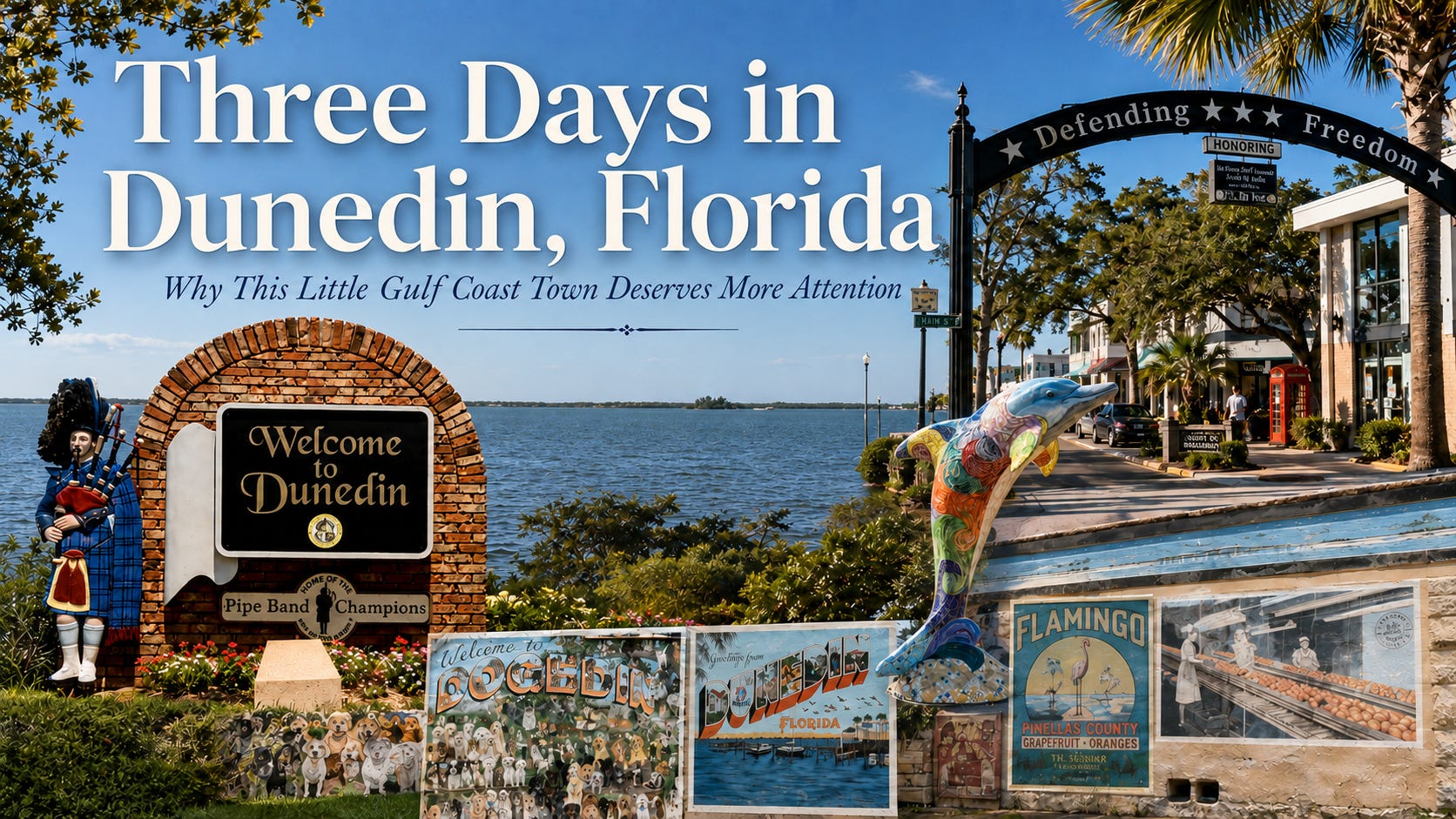
I’m starting to think some of the best Florida trips happen when we quit looking for the biggest attraction on the map.
Dunedin was one of those trips.
There wasn’t one giant, must-see thing that brought us here. No theme park. No massive resort complex. No attraction that required us to buy tickets six months in advance and schedule our bathroom breaks around an app.
We came because we were curious.
And after three days of walking, driving, eating, drinking, talking to people, chasing sunsets, taking entirely too many pictures and occasionally remembering that we were supposed to be on vacation, Dunedin turned out to be exactly the kind of Florida town we keep hoping to find.
It’s quirky without trying too hard to be quirky. Historic without feeling trapped in the past. There’s water everywhere, a legitimately walkable downtown, local restaurants and shops, public art, Scottish touches, beaches nearby and enough strange little details that we kept stopping every few minutes to take another picture.
And, apparently, oranges everywhere.
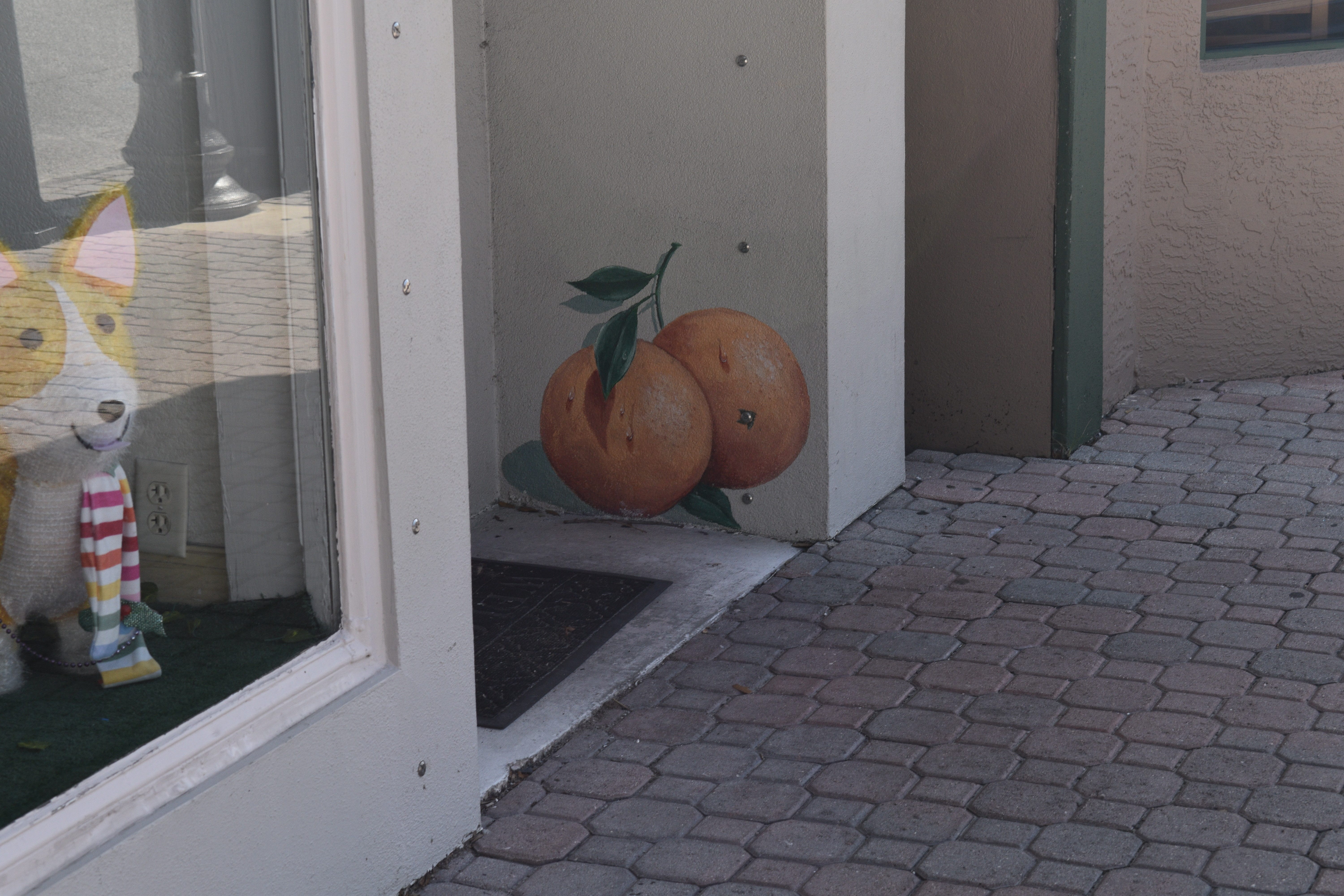
More on those later.
First Things First: It’s Dun-EE-din
We should probably get that out of the way.
Dunedin is pronounced dun-EE-din, and the name comes from the Scottish Gaelic Dùn Èideann. The city’s official history says Scottish merchants John O. Douglas and James Somerville arrived in the area in the 1880s, petitioned for a post office, and the post office — and eventually the town — took the Dunedin name.
But one of the things we learned at the Dunedin History Museum was that the Scottish story is a little more complicated than the simplified “a bunch of Scots founded the town” version you sometimes hear.
The Scottish identity became much stronger over time.
Dunedin embraced it through street names, tartan, bagpipes, Highland dancing and eventually the Dunedin Highland Games, which began in 1967. The city still has a pipe band, Scottish cultural organizations and enough tartan around town that you definitely aren’t going to forget the connection.
You notice it almost immediately.
There’s a bagpiper on the Welcome to Dunedin sign. There’s a Scottish cultural center. We found a little mosaic photo opportunity where you can stand behind it and suddenly find yourself wearing a kilt.
Naturally, we took the picture.
We’re professionals.
Downtown Dunedin Is Better When You Wander
We made the mistake — if you want to call it that — of arriving downtown early on a Monday.
Dunedin apparently does not believe Monday morning should be rushed.
A lot of places weren’t open yet. Some opened at 10:30. Some at 11. Some at noon.
Some simply looked at Monday and said, “Nope.”
That’s actually a useful planning tip: if shopping and hitting every downtown business is important to you, Monday morning probably isn’t your ideal Dunedin window.
But the upside was that parking was easy and we had plenty of room to walk around and take pictures without constantly stepping around crowds.
Downtown is very walkable once you’re in the core, and the regional tourism office confirms there are free public parking options around downtown.
What surprised me was that downtown doesn’t feel like one manufactured tourist strip.
It spreads out.
Restaurants sit beside homes. A brewery suddenly appears around the corner. There are murals, salons, shops, little parks, a red British phone booth, dogs everywhere and enough small visual details that Jodie and I kept pointing things out to each other.
“Look at that.”
“Oh, that’s cute.”
“Wait, get a picture of that.”
Which is basically how you end up with 68 Nikon pictures before you realize you’ve been in town for about five minutes.
The Pinellas Trail runs directly through downtown, and that matters more once you know what you’re looking at. The trail follows part of Dunedin’s old railroad corridor — the Orange Belt Railway helped shape the town and connected Dunedin to the broader region. Today, people bike and walk through the same general corridor that once moved passengers, mail, citrus and freight.
That’s the kind of history I enjoy.
You don’t need to memorize a date.
You’re standing on it.
The Museum Was Worth the Stop
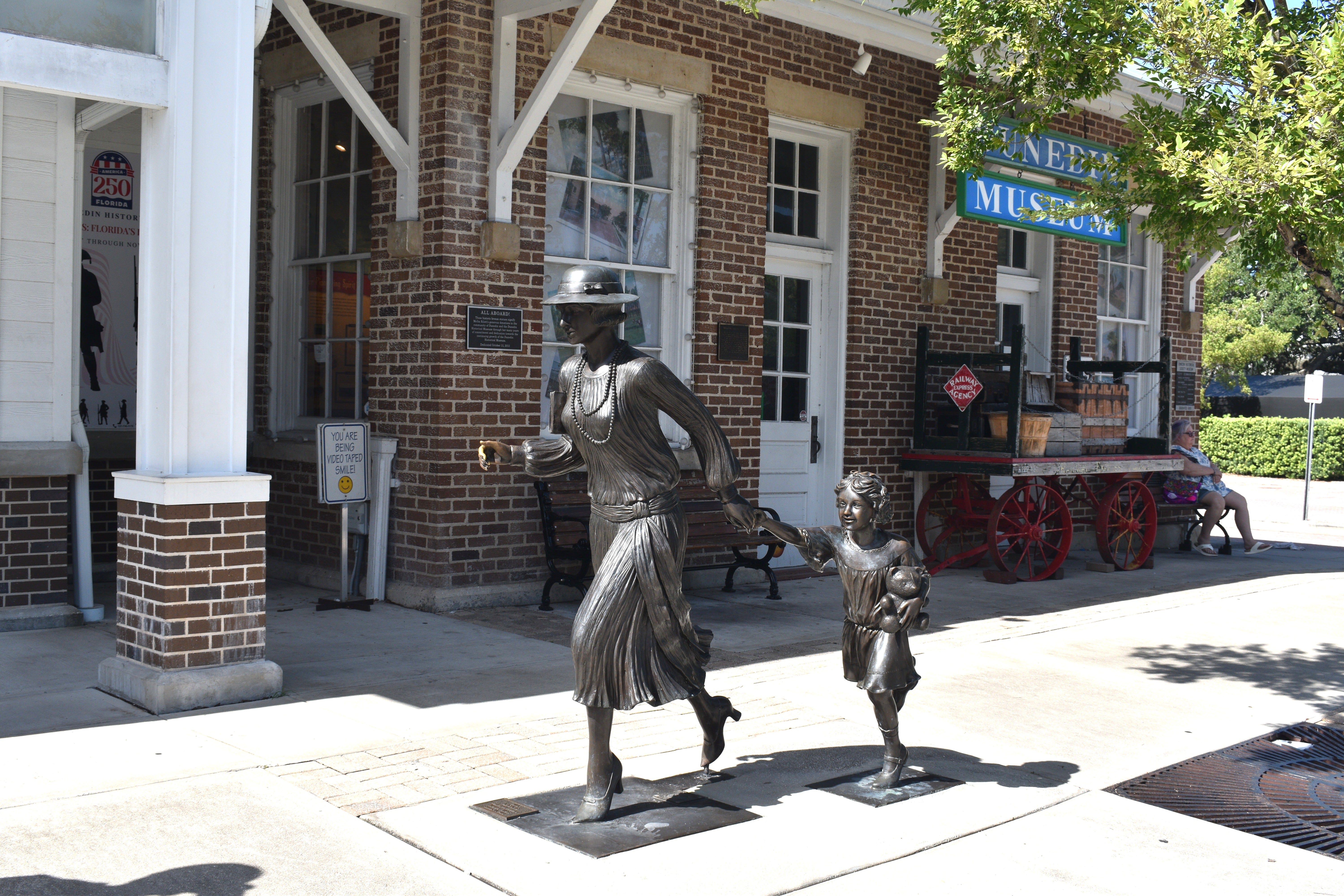
We went into the Dunedin History Museum, housed in the city’s old railroad station, mostly because I wanted enough history to understand what we were looking at around town.
The regional tourism office identifies the building as the 1924 Atlantic Coast Line Railroad Station.
I figured we would walk through quickly.
We did not walk through quickly.
I came out with roughly 27 photographs of historical displays, which is apparently what happens when you give me a camera and tell me there might be useful information for the blog.
The museum filled in a lot of blanks.
Early Dunedin was citrus country. The railroad mattered. Tourism mattered. Winter visitors mattered. The town grew, changed, struggled and eventually reinvented itself.
One of my favorite pieces of history involved Dunedin incorporating in the late 1800s partly because residents were tired of roaming hogs tearing up gardens and property.
There was apparently even a hog jail.
Every town needs an origin story.
Dunedin having one involving incarcerated pigs feels completely appropriate.
We also learned how important tourism became fairly early in the town’s development. Hotels and boarding houses began serving winter visitors from the North, setting the stage for places like the Fenway Hotel that would come later.
The Fenway turned into a much bigger part of this trip than we expected. Here’s our stay at Dunedin’s historic Fenway Hotel, including HEW, the rooftop sunsets and the pool time Jodie wisely insisted on.
The People May Have Been Our Favorite Part
This keeps happening on our trips.
We go somewhere looking for buildings, restaurants and things to do.
Then we end up remembering the people.
While wandering downtown, we stopped to look at some real estate listings because Jodie and I are apparently incapable of visiting a Florida town without eventually asking, “What would it cost to live here?”
That led us into a conversation with Eamon Bolton, a local real estate agent.
We weren’t planning to talk to a realtor.
We definitely weren’t planning to spend that long talking to one.
But Eamon was one of those people who immediately felt less like someone trying to sell us something and more like somebody who genuinely loves the area and enjoys talking about it.
We talked about Dunedin, Safety Harbor, Tarpon Springs, real estate, hurricanes, food, local produce and eventually travel blogging.
Then we discovered he also has a food-focused project centered around Tarpon Springs.
That got our attention.
By the time we walked out, Jodie and I had both reached basically the same conclusion: if we were seriously buying property in this area, he’s exactly the kind of person we’d call.
And the conversation paid off in another way.
He gave us restaurant recommendations and local stories that we never would have gotten from a Google search.
That is becoming one of my favorite parts of traveling this way.
Talk to people.
Not every useful travel tip is sitting on a website waiting to be ranked.
Honeymoon Island Before Florida Remembered It Was August
One morning we drove out across the Dunedin Causeway to Honeymoon Island State Park.
We deliberately went early.
Partly because I wanted photographs before the crowds showed up.
Mostly because this is Florida in August and I have enough sense to know that anything involving walking should probably happen before the sun gets fully motivated.
Honeymoon Island State Park opens at 8 a.m.; current admission is $8 per vehicle for up to eight people.
Even early, it was already surprisingly hot.
And still.
Very still.
We stopped around the nature center, looked through the exhibits, wandered along the water and seagrass, took pictures and admired the barrier-island landscape.
Honeymoon Island sits just offshore from Dunedin across St. Joseph Sound, and that drive across the causeway really helps you understand the geography of this part of Florida.
Then, after walking around for a while, we made the bold decision not to pretend we were about to embark on some six-mile nature expedition.
Sometimes the travel-blog version of an outing is:
“We explored the pristine natural environment.”
The real version is:
“That was really nice. It’s hot as hell. You ready?”
Yes.
Yes, we were.
Honeymoon Island itself has enough history to deserve a separate story, including the fact that it and Caladesi were once part of one island before a hurricane changed the landscape.
We’ll come back to that one.
A Little Food Detour That Turned Out Better Than Expected
One of our more random stops was Carvor’s Fish House.
We weren’t starving and it wasn’t some carefully researched reservation.
We were driving around, recognized the place and decided to stop.
Those are often the meals I enjoy most.
I had conch fritters and a blackened scallop skewer.
Jodie doesn’t do seafood, so she went with the beer-cheese hushpuppies and macaroni salad.
Her assessment of the hushpuppies was pretty specific: they were good, but she really didn’t get much “beer cheese” from them.
The macaroni salad, though, tasted genuinely fresh and was much better than the obligatory scoop of mayonnaise-covered sadness you occasionally get as a side somewhere.
My scallops were better than I expected.
The conch fritters were good.
Then we got to the key lime square.
That crust.
I remember Jodie saying it may have been the best crust she’d ever had on a key lime dessert.
Fantastic.
Sometimes you don’t need a tasting menu.
You need a basic table, a couple of good bites and something involving key lime.
And Eventually, We Stopped
There’s something else I want to remember from this trip.
At some point, we had to stop gathering material.
Travel blogging creates a weird temptation.
You start thinking:
We should photograph that.
We should walk one more block.
We should try one more restaurant.
We should stop at one more shop.
We should get video.
We should get a better picture.
We should—
No.
At some point, you have to stop researching the vacation and actually have the vacation.
By mid-afternoon one day, we’d already been out exploring, taking pictures and driving around.
Jodie wanted some pool time.
So we went back to the Fenway and had pool time.
That sounds stupidly obvious until you start turning travel into work.
I don’t want Trip Jar to become the reason we stop enjoying the trips that created Trip Jar in the first place.
The best travel advice we may have picked up in Dunedin had nothing to do with parking, restaurants or admission prices.
Sometimes you’ve done enough.
Go back to the hotel.
Get in the pool.
Dunedin Is Easy to Like
I understand why people get attached to this place.
It has the water and beaches people expect from Florida, but the actual town has its own personality.
Downtown is walkable.
The Pinellas Trail runs straight through it.
There are independent restaurants, breweries, shops, art and music. Honeymoon Island is just down the causeway. The official tourism guides lean heavily into exactly that combination — small-town downtown, beaches, cycling, local food and Scottish heritage — and after spending a few days here, that description actually fits.
But what made Dunedin work for us wasn’t any single attraction.
It was finding something interesting around the next corner.
A mural.
A strange little shop.
A railroad station.
A conversation with somebody we didn’t know five minutes earlier.
A really good piece of key lime dessert.
A sunset that made us almost forget about dinner.
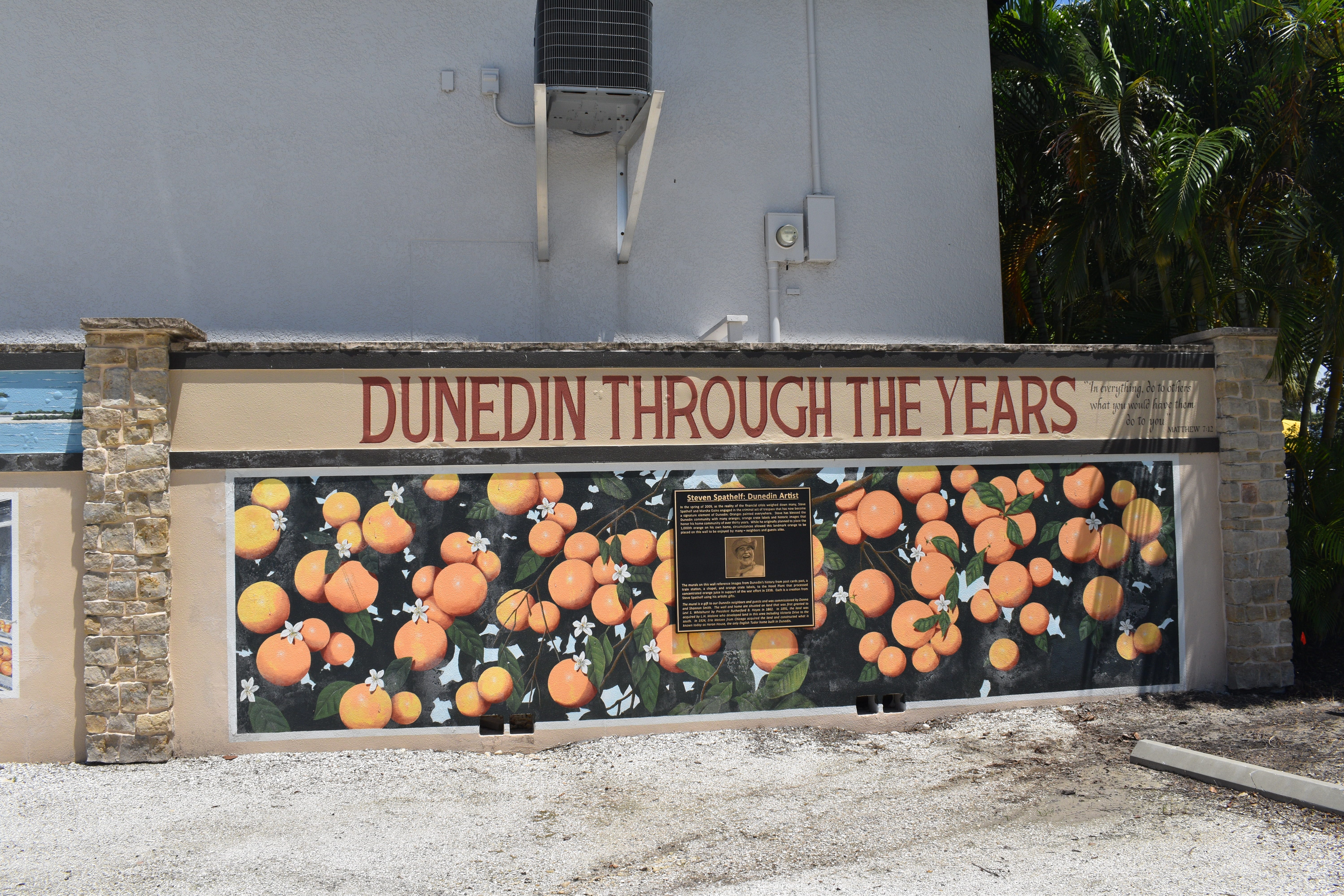
And occasionally realizing that the weird orange painted on the side of a building probably wasn’t the last one we were going to see.
Because if you’ve been looking closely at our Dunedin pictures, you may have noticed them too.
Oranges.
Little ones.
Big ones.
Hidden ones.
Murals full of them.
They started showing up everywhere.
And no, we haven’t forgotten about them.
There is an actual story behind Dunedin’s random oranges.
More to come.